
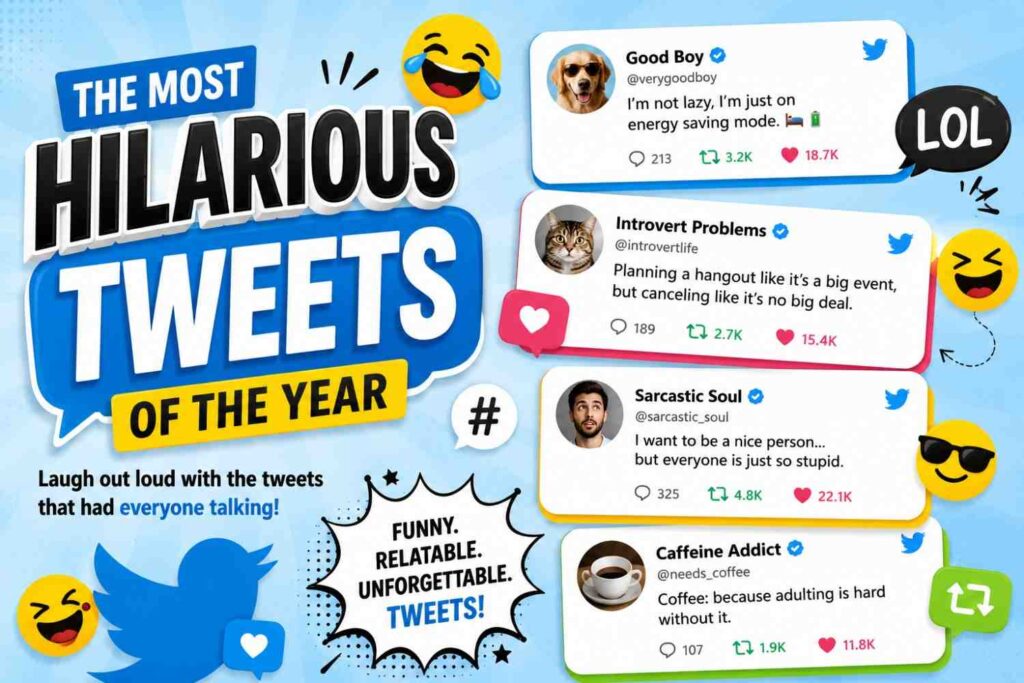
The Most Hilarious Tweets of the Year: Funny, Viral, and Too Relatable
The Most Hilarious Tweets of the Year are not just random jokes that happened to get attention online. They are small, sharp reflections of how people experienced the year through humor, sarcasm, memes, and shared frustration. A single tweet can capture the mood of millions of people in one sentence, whether it is about work burnout, family life, dating, celebrity drama, technology, or the strange little problems of everyday life.
Even though X now officially uses the word “posts,” many readers still search for “tweets” when looking for funny social media content. That is why this article uses both terms naturally. The word “tweets” still carries strong search value, while “X posts” helps keep the article current and accurate.
In this guide, we will look at why funny tweets still matter, what makes a tweet genuinely hilarious, which types of posts people love most, and how to find The Most Hilarious Tweets of the Year without relying on weak screenshots or recycled jokes. Whether you are a casual reader, blogger, social media manager, or content publisher, this guide will help you understand what makes online humor travel so quickly.
Quick Answer About The Most Hilarious Tweets of the Year
The Most Hilarious Tweets of the Year are usually short, clever, relatable, and perfectly timed posts that capture the funniest parts of everyday life and internet culture. They often come from ordinary people who describe a common feeling in a surprisingly accurate way. Some are based on viral events, while others are about work, relationships, parenting, money, food, pets, or social awkwardness.
The best funny tweets are not always the ones with the highest number of likes. Sometimes, a tweet becomes memorable because people keep sharing it in group chats, quoting it in replies, turning it into memes, or saving it as a screenshot. A strong yearly roundup should include viral tweets, underrated jokes, meme reactions, and relatable posts that feel fresh even after the trend has passed.
For readers, these posts offer quick entertainment. For publishers, they provide a strong opportunity to create an SEO-friendly, shareable, and culturally relevant article. The key is to organize the content clearly, provide context where needed, and avoid presenting unverified screenshots as confirmed public posts.
Why Funny Tweets Still Matter in Internet Culture
Funny tweets continue to matter because they represent one of the fastest and most accessible forms of online humor. A tweet does not need a long introduction, a full video setup, or professional editing. It can be one sentence, one observation, or one sarcastic response that instantly connects with thousands of people. This simplicity is what makes social media humor so powerful.
In a world where people scroll quickly and consume content in short bursts, funny X posts fit naturally into modern reading habits. They are easy to understand, easy to share, and easy to remember. A strong joke can move from X to Instagram, TikTok, Reddit, WhatsApp, newsletters, and blog roundups within hours.
The Most Hilarious Tweets of the Year also help document the emotional tone of a year. They show what people were tired of, excited about, confused by, or laughing through. Some jokes become popular because they are attached to major news or pop culture events. Others go viral because they describe ordinary life with uncomfortable accuracy. Together, these posts create a humorous record of how people talked, reacted, and coped online.
Short Jokes Fit Modern Reading Habits
Short jokes work well because most online readers do not want to work hard to understand humor. They want a quick payoff. A funny tweet usually succeeds when it sets up a situation clearly and delivers the punchline before the reader loses interest. This is especially important on fast-moving platforms where users scroll past dozens of posts in a minute.
The best funny tweets often use simple language, but that does not mean they are poorly written. Many are carefully shaped around timing, rhythm, and surprise. A strong tweet may start with an ordinary thought and then twist it in a way that feels unexpected but true. That combination of simplicity and surprise is what makes the joke stick.
For content publishers, this means a roundup should respect the fast-reading nature of the format. Each selected post should be easy to enjoy without too much explanation. If a joke needs five paragraphs of background to make sense, it may not belong in a general yearly collection. The goal is to create a reading experience that feels light, smooth, and entertaining while still offering enough context for readers who missed the original trend.
Tweets Capture the Mood of the Year
Funny tweets often become popular because they say what many people are already feeling. During stressful, exciting, or confusing moments, people use humor to process the situation. A joke about inflation, work meetings, awkward family gatherings, or a viral celebrity moment can spread quickly because it gives people a shared way to laugh at something familiar.
This is one reason The Most Hilarious Tweets of the Year can feel more meaningful than a basic list of jokes. A good roundup shows patterns. It reveals what people complained about, what they celebrated, what annoyed them, and what made them feel seen. Humor becomes a kind of cultural snapshot.
For example, a tweet about pretending to be productive at work may seem small, but it connects to larger conversations about burnout, remote work, and modern office culture. A meme tweet about dating apps may reflect wider frustration with online relationships. When curated properly, funny tweets help readers revisit the year through the language of the internet. They are entertainment, but they are also social commentary in a very compact form.
What Makes a Tweet Truly Hilarious?
A tweet becomes truly hilarious when it combines clarity, timing, originality, and emotional recognition. Many posts try to be funny, but only a few make people stop scrolling, laugh, and share them with someone else. The difference usually comes down to how well the joke understands the audience. A strong funny tweet makes readers feel that the writer has noticed something they also experience but could not express as neatly.
The best funny tweets rarely depend on complicated wording. Instead, they rely on precision. The writer chooses the exact situation, emotion, or contradiction that makes the joke work. This could be a relatable complaint, an exaggerated reaction, a clever comparison, or a perfectly timed response to a trending topic.
It is also important to understand that viral tweets and hilarious tweets are not always the same. Some viral posts spread because they are controversial, shocking, or attached to a major news moment. A genuinely funny tweet spreads because people enjoy it and want others to enjoy it too. When selecting The Most Hilarious Tweets of the Year, the focus should be on humor quality, not just engagement numbers.
| Element | Why It Makes Tweets Funny | Reader Impact |
|---|---|---|
| Relatability | Reflects everyday experiences people recognize. | Creates an instant emotional connection. |
| Timing | Matches trending events or conversations. | Increases sharing and engagement. |
| Originality | Offers a fresh perspective or unexpected punchline. | Makes the joke memorable. |
| Simplicity | Delivers humor in a short, clear format. | Easy to understand and share. |
| Surprise | Ends with an unexpected twist. | Encourages laughter and reposts. |
| Emotional Recognition | Expresses common thoughts people rarely say aloud. | Makes readers feel understood. |
Relatability Is the Strongest Comedy Trigger
Relatability is one of the strongest reasons people laugh at tweets. A joke becomes powerful when readers immediately think, “That is exactly me.” These tweets often focus on everyday experiences such as being tired, avoiding responsibilities, checking the fridge repeatedly, surviving meetings, dealing with family messages, or pretending to understand adult life.
Relatable tweets work because they do not require special knowledge. A reader does not need to follow a celebrity story or understand a niche meme format to enjoy them. The humor comes from recognition. The tweet points at a normal situation and makes it feel funnier, sharper, or more honest than usual.
For SEO content, relatable tweets are especially valuable because they have long-term appeal. A joke about being tired on a Monday or spending too much money on food delivery can still make sense months later. This makes them useful for yearly roundups because they do not expire as quickly as trend-specific jokes. When building a professional article, I recommend including a strong mix of relatable humor so the content remains enjoyable even after the original viral moment has passed.
Timing Makes a Joke Travel Faster
Timing can turn a simple joke into a viral moment. When people are already talking about an event, a fast and funny reaction can travel much further than the same joke posted days later. This is especially true for award shows, sports events, celebrity interviews, political debates, product launches, TV finales, and unexpected internet drama.
A well-timed tweet benefits from existing attention. The audience is already online, already reacting, and already looking for clever commentary. If a post captures the mood quickly, it can become part of the event itself. People may remember the joke almost as much as the original moment that inspired it.
However, timing alone is not enough. A fast joke still needs to be clear and original. Many people react to the same trend, so the funniest post is usually the one that finds a fresh angle. For publishers, this means a yearly roundup should not include a tweet only because it was posted during a viral event. It should still be genuinely funny, easy to understand, and worth revisiting after the trend has cooled down.
Main Types of Hilarious Tweets Readers Love
The strongest funny tweet roundups include a range of humor styles. If every post has the same tone, readers may lose interest quickly. Variety keeps the article moving and gives different readers something to enjoy. Some people love sarcastic work jokes. Others prefer family humor, pop culture commentary, meme reactions, or dry one-liners about everyday life.
A professional roundup should feel organized rather than random. Grouping tweets by theme helps readers move through the article naturally. It also improves SEO because each section can target related keywords such as relatable tweets, meme tweets, viral tweets, funny X posts, and pop culture tweets. This structure helps both human readers and search engines understand the page.
The Most Hilarious Tweets of the Year usually include a blend of timeless jokes and trend-based humor. Timeless jokes keep the article readable for longer. Trend-based jokes make the article feel current and connected to the year’s biggest online conversations. When both are balanced, the article becomes more engaging and more useful.
Relatable Everyday Tweets
Relatable everyday tweets are often the backbone of a funny yearly roundup. These posts focus on common situations that almost everyone understands. They may joke about waking up tired, avoiding emails, spending too much on small treats, struggling with chores, or pretending to be confident in situations where no one really knows what they are doing.
The reason these tweets work so well is that they make ordinary life feel shared. A reader may be alone on their phone, but the joke reminds them that thousands of other people have the same habits, worries, and small failures. That feeling of recognition creates an instant connection between the writer and the audience.
For a professional article, everyday humor also provides stability. Trend-based jokes can become confusing if readers do not remember the original event, but a good relatable tweet needs very little context. It can sit comfortably in a roundup and still make sense later. When selecting examples, choose posts that are specific enough to be funny but broad enough for most readers to understand. The best ones feel personal and universal at the same time.
Pop Culture and Meme Tweets
Pop culture and meme tweets bring energy to a roundup because they connect humor to moments people already recognize. These posts may react to a movie release, a celebrity appearance, a viral interview, a sports moment, a music trend, or a TV scene that dominated online conversation. When done well, they help readers relive the year’s most talked-about moments through comedy.
Meme tweets work slightly differently. They often depend on familiar formats, repeated phrases, image templates, or shared internet references. A meme tweet can be hilarious because it applies a known format to a new situation in a clever way. Readers enjoy the surprise of seeing a familiar joke structure used in a fresh context.
The challenge with pop culture and meme tweets is context. A joke that was obvious during a viral moment may become confusing months later. That is why publishers should add a short explanation when needed. A single sentence can be enough to remind readers what happened without overexplaining the humor. The goal is to support the joke, not flatten it. Good context helps the article feel polished and accessible to readers who were not online during the original trend.
How to Find The Most Hilarious Tweets of the Year
Finding The Most Hilarious Tweets of the Year requires more care than simply searching for “funny tweets” and copying the first results. A strong collection should feel curated, not scraped together. The best approach combines keyword research, platform search, trend tracking, manual review, and source checking.
A good curator looks for humor quality, not only engagement. Some excellent jokes come from smaller accounts and never reach massive numbers. At the same time, some highly viral posts are not suitable for a professional website because they rely on insults, misinformation, harassment, or missing context. The goal is to select posts that are funny, understandable, safe to share, and relevant to the year.
It also helps to create a simple system before collecting posts. Track the post link, author name, date, topic, humor category, and any context needed. This prevents confusion later and makes it easier to organize the article into sections. For advanced publishers, this process also supports better editorial review, attribution, and update management.
Step-by-Step Curation Process
Start by identifying the major humor categories you want to cover. These may include work tweets, parenting tweets, dating tweets, pop culture tweets, pet tweets, food tweets, money jokes, and meme reactions. Once you have categories, search for keyword variations such as “funniest tweets of the year,” “best funny tweets,” “viral tweets this year,” “funny X posts,” and “most relatable tweets.”
Next, review public posts carefully. Do not rely only on screenshots, because screenshots can be edited, cropped, or removed from context. Whenever possible, find the original post link and confirm that the content is still publicly available. Save potential entries in a spreadsheet or document with notes about why each post is funny and where it might fit.
After collecting a large group of candidates, narrow the list. Remove duplicates, weak jokes, posts that require too much explanation, and anything that may create unnecessary risk for your site. Finally, arrange the selected posts in a natural order. Start with broad, accessible jokes, then move into more specific categories. This helps readers settle into the article before encountering jokes that need more background.
Use This Simple Selection Table
A clear selection table can make the curation process more consistent. It is especially useful if more than one person is working on the article. Instead of choosing posts based only on personal taste, the table gives editors a practical framework for judging whether a tweet belongs in the final roundup.
| Selection Factor | Why It Matters | Best Practice |
|---|---|---|
| Originality | Helps avoid recycled jokes and copied formats | Check whether the same joke appears across many accounts |
| Context | Makes the joke easier to understand | Add a short note if the post depends on a trend or event |
| Shareability | Shows whether readers may enjoy passing it on | Choose jokes people would send to friends or quote in conversation |
| Safety | Protects the website from careless publishing | Avoid private information, harassment, misleading screenshots, and harmful claims |
| Variety | Keeps the roundup interesting | Mix relatable, meme, pop culture, work, family, and everyday humor |
| Longevity | Helps the article stay useful after the trend fades | Include jokes that remain funny without heavy context |
This table is not meant to remove personality from the article. Humor still requires human judgment. However, it helps keep the final roundup balanced, professional, and reader-friendly.
How to Publish a Funny Tweet Roundup Safely
Publishing a funny tweet roundup requires both creativity and responsibility. A post may be public, but that does not mean it should be copied carelessly or presented without context. A professional article should respect creators, avoid misleading readers, and follow basic editorial standards.
The safest approach is to use original public links or embeds whenever possible. This keeps attribution visible and gives readers a direct connection to the source. It also reduces the risk of relying on edited screenshots or incomplete quote chains. If a post has been deleted, protected, or cannot be verified, it is usually better to leave it out.
Another important point is tone. A funny roundup should not become a list of posts mocking private individuals, spreading rumors, or encouraging harassment. Humor can be sharp without being irresponsible. Choose posts that are clever, relatable, or culturally relevant rather than cruel. This improves the quality of the article and makes it more suitable for a professional website.
Embed Public Posts When Possible
Embedding public posts is usually the best option for a blog article because it preserves attribution and allows readers to see the original source. It also helps separate verified posts from random screenshots circulating online. When a reader can click through to the original post, the article feels more trustworthy and transparent.
Embeds also help with context. A post may include replies, quote posts, or a larger conversation that gives the joke more meaning. While readers do not need to investigate every source, having the original link available gives them the option. This is especially useful for pop culture tweets, reaction jokes, and posts tied to breaking trends.
That said, embeds should be used thoughtfully. Too many embedded posts can slow down a page and make the layout feel cluttered. A good article balances embeds with short commentary, section introductions, and clean formatting. If you use screenshots for design reasons, make sure the original source is still credited. The goal is to make the article entertaining while still respecting the people who created the humor.
Do Not Remove Context
Context matters because a tweet can change meaning when separated from the conversation around it. Some posts are replies. Some are quote posts. Some are part of a longer thread. Others are jokes responding to a specific event that may not be obvious later. If you remove that context, readers may misunderstand the humor or, worse, take the post in a misleading direction.
Before including a tweet in a professional roundup, check whether the post stands alone. If it depends on a trend, add a short explanation. If it depends on another person’s post, make sure the relationship between the two is clear. If the joke only works by targeting someone unfairly, reconsider whether it belongs in the article.
Good context should be brief. You do not need to explain every part of the joke. In fact, overexplaining can weaken humor. A single sentence such as “This post became popular during the award show reactions” or “This joke played off a viral work-from-home trend” is usually enough. The purpose is to help readers enjoy the humor without confusion.
SEO, AEO, and GEO Tips for This Topic
The topic The Most Hilarious Tweets of the Year may sound purely entertainment-focused, but it still benefits from strong SEO, AEO, and GEO structure. Search engines need to understand the page clearly, and readers need to find the answer they came for quickly. A well-structured article can satisfy both needs without sounding robotic.
For SEO, the article should use the main keyword naturally in the title, introduction, quick answer, body, FAQ, and conclusion. Related terms such as funny tweets, viral tweets, hilarious Twitter posts, funny X posts, meme tweets, and social media humor should appear where they fit. The goal is not to repeat the same phrase over and over, but to cover the topic fully using natural language.
For AEO and GEO, the article should include direct answer blocks, question-based headings, tables, clear definitions, and practical steps. These elements help answer engines and generative systems understand the content. More importantly, they help human readers skim the page and find useful information quickly.
| Topic Area | Related Entities & Concepts | Purpose in the Article |
|---|---|---|
| Social Platform | X (Twitter), public posts, reposts | Defines where the content originates. |
| Humor Types | Relatable humor, sarcasm, memes, one-liners | Covers different comedy styles. |
| Viral Content | Trending topics, internet culture, online reactions | Explains why posts spread quickly. |
| Pop Culture | Celebrities, TV shows, sports, entertainment | Adds timely and recognizable context. |
| Content Curation | Original sources, attribution, public links | Supports trustworthy publishing. |
| SEO & AI Optimization | Featured snippets, answer engines, semantic search | Improves discoverability across search and AI systems. |
Write for Readers First
People-first writing is essential for this topic. Readers searching for funny tweets want entertainment, but they also appreciate structure, context, and originality. A thin list of copied jokes may attract clicks briefly, but it does not create a strong reading experience. A better article explains why certain tweets were funny, what type of humor they represent, and how they connect to the wider online conversation.
Writing for readers first also means avoiding keyword stuffing. A sentence should never exist only to insert a search term. Instead, keywords should appear naturally as part of useful explanations. For example, the phrase “funniest tweets of the year” fits well when discussing reader search intent, while “viral tweets” fits naturally in a section about popularity and timing.
Advanced readers, such as marketers or publishers, may also want practical insight. That is why this article includes curation steps, safety guidance, and selection criteria. Beginners can enjoy the simple explanations, while experienced content creators can use the framework to build better roundups. This balance makes the article stronger for SEO and more valuable for a professional audience.
Make the Article Easy for Answer Engines
Answer engines and AI-driven search systems prefer content that is clear, structured, and easy to interpret. That does not mean the writing should sound mechanical. It means the article should answer obvious questions directly and then expand with useful detail. A quick answer near the beginning is especially helpful because it gives readers an immediate response before they continue into deeper sections.
Question-based headings also improve discoverability. Headings such as “What makes a tweet truly hilarious?” or “Where can I find the funniest tweets of the year?” match natural search behavior. Many people now search in full questions, especially through voice assistants and AI search tools. Clear headings make it easier for those systems to identify relevant answers.
Entity-rich writing also supports GEO. Mentioning X, Twitter, posts, memes, public posts, protected posts, online reactions, social media trends, and internet culture helps define the topic more completely. The key is to include these terms naturally. When the article explains the topic from multiple angles, it becomes more useful for readers and easier for search systems to understand.
Common Mistakes to Avoid
A funny tweet roundup can lose quality quickly if it becomes lazy, repetitive, or poorly organized. The biggest mistake is assuming that a collection of jokes is automatically a strong article. Readers still need structure, context, and a reason to keep scrolling. If the post feels like a random dump of screenshots, it may not perform well beyond a short burst of traffic.
Another common mistake is focusing only on viral metrics. High likes or reposts do not always equal high-quality humor. Some posts go viral because they are controversial, confusing, or attached to drama. A professional website should prioritize jokes that are genuinely funny, understandable, and safe to present.
Writers should also avoid over-optimizing the article. The main keyword is important, but repeating The Most Hilarious Tweets of the Year in every section will make the content sound unnatural. Good SEO is about relevance and readability, not forced repetition. A polished article uses variations, examples, and supporting terms to build topical depth.
Do Not Stuff the Keyword Everywhere
Keyword stuffing weakens both readability and trust. If the main phrase appears too often, the article starts to feel written for an algorithm rather than a person. Readers notice this quickly, especially in entertainment content where the tone should feel smooth and conversational.
A better strategy is to use the main keyword in the most important places: the meta title, meta description, URL slug, H1, introduction, quick answer, one body section, FAQ, and conclusion. After that, use natural variations such as funny tweets, funniest tweets of the year, viral tweets, hilarious Twitter posts, funny X posts, meme tweets, and social media humor.
This approach helps avoid keyword cannibalization and improves semantic coverage. It also makes the article easier to read. Search engines have become better at understanding related terms, so there is no need to repeat one exact phrase unnaturally. The goal is to make the page clearly about the topic while keeping the writing human. Strong SEO should feel invisible to the reader.
Do Not Overload the Page
A page overloaded with too many embeds, screenshots, or long explanations can become difficult to read. Even readers who came for humor may leave if the article feels slow, messy, or visually overwhelming. Funny content should be easy to move through. The layout should support the jokes rather than compete with them.
One practical solution is to group posts by theme. Instead of placing dozens of tweets in a single long list, organize them into sections such as everyday life, work, relationships, pop culture, pets, parenting, and memes. This makes the article easier to scan and gives readers natural stopping points.
It is also important to avoid overexplaining every joke. Context is useful, but comedy loses impact when the explanation becomes longer than the punchline. Use short notes only where needed. Keep paragraphs clear, avoid clutter, and make sure the page loads smoothly. A professional roundup should feel curated, not crowded. Quality matters more than quantity, especially when the goal is long-term search performance.
Frequently Asked Questions
The FAQ section helps answer common search questions in a clear and direct way. It is useful for readers who want quick information and for search engines that look for concise answers. These questions also help cover natural keyword variations without forcing them into the main body of the article.
A strong FAQ section should not repeat the same points in different words. Each answer should solve a slightly different reader need. Some readers want to know what makes a tweet funny. Others want to know where to find them, whether tweets are still called tweets, or how to use them safely in a blog post.
For this topic, the FAQ section also supports AEO and GEO optimization. The questions are phrased in a natural way, similar to how people search or ask voice assistants. The answers are short enough to scan but detailed enough to provide real value.
What are The Most Hilarious Tweets of the Year?
The Most Hilarious Tweets of the Year are the funniest, most memorable, and most widely shared social media posts from a specific year. They often include relatable jokes, pop culture reactions, meme commentary, and clever observations about everyday life. The strongest examples usually feel timely, original, and easy to understand.
These tweets do not always have to be the most liked posts on X. Sometimes, a smaller post becomes memorable because it captures a feeling perfectly. A good roundup should include both viral tweets and underrated gems. The goal is to show what made people laugh, what moments shaped online humor, and why those jokes still feel worth reading later.
Are tweets still called tweets?
Many people still call them tweets because the word has been part of internet culture for many years. However, X now officially refers to them as posts. This means writers and publishers should understand both terms. Using “tweets” helps match reader search behavior, while using “X posts” keeps the article accurate and up to date.
For SEO, it is usually best to include both terms naturally. A headline may use “tweets” because that is what readers commonly search for, while the body can explain that the platform now uses “posts.” This avoids confusion and helps the article reach a wider audience without sounding outdated.
Where can I find the funniest tweets of the year?
You can find the funniest tweets of the year by searching X, reviewing public creator profiles, checking meme accounts, reading entertainment roundups, and tracking viral social media trends. Search variations such as “funniest tweets of the year,” “best funny tweets,” “viral tweets,” and “funny X posts” can help you discover strong examples.
However, it is important to verify the original source before publishing anything. Screenshots are often reposted without context and may not always be reliable. For a professional article, save the original link, check whether the post is public, and make sure the joke still makes sense outside its original timeline.
What makes a funny tweet go viral?
A funny tweet usually goes viral because it is relatable, timely, simple, and easy to share. People are more likely to repost or quote something when it describes a feeling they already recognize. Strong wording, surprise, and cultural timing also play an important role.
Viral humor often works best when it connects to a shared experience. A joke about work stress, awkward conversations, dating apps, or a major pop culture event can spread quickly because many people understand it immediately. Still, virality should not be the only standard. A tweet can be hilarious even if it never reaches massive engagement numbers.
Can I use funny tweets in my blog article?
You can usually reference or embed public posts in a blog article, but you should do it carefully. Always check the original source, keep attribution visible, and avoid using protected, deleted, or unverified posts. If a tweet appears only as a screenshot and you cannot confirm where it came from, it may be safer not to include it.
A professional roundup should also avoid content that spreads private information, harassment, or misleading claims. Humor should add value to the reader experience. When in doubt, choose posts that are public, clearly credited, and easy to understand without damaging someone’s privacy or reputation.
Should a yearly tweet roundup include screenshots or embeds?
Embeds are usually better than screenshots because they preserve attribution and connect readers to the original public post. They also help readers see whether the post still exists and whether it was part of a larger conversation. This makes the article more transparent and trustworthy.
Screenshots may still be useful for design or social sharing, but they should be used carefully. A screenshot can be edited, cropped, or separated from important context. If you use screenshots, keep the creator credited and verify the original post whenever possible. For professional publishing, original links and embeds are usually the stronger choice.
Conclusion
The Most Hilarious Tweets of the Year offer more than quick laughs. They show how people reacted to everyday struggles, viral trends, pop culture moments, and shared frustrations throughout the year. A good funny tweet can turn a common feeling into a memorable punchline, and a strong yearly roundup can turn those posts into a readable, entertaining, and culturally relevant article.
For publishers, the best approach is to curate carefully. Choose posts that are funny, original, easy to understand, and safe to share. Use public links or embeds where possible, add short context when needed, and organize the article by humor type so readers can move through it naturally. Avoid keyword stuffing, overloaded layouts, and unverified screenshots.
When written professionally, a roundup of funny tweets can serve both readers and search engines. It can entertain casual visitors, support SEO goals, answer common questions, and preserve the funniest online moments of the year in one place.