
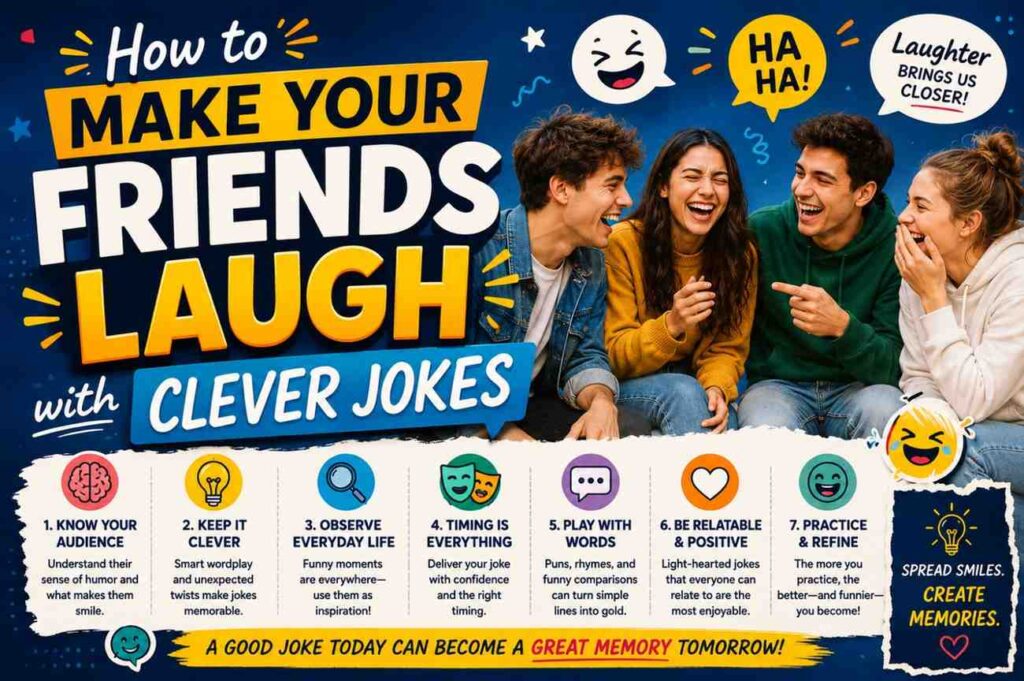
How to Make Your Friends Laugh with Clever Jokes
Humor is one of the most powerful social tools anyone can develop. A well-timed joke can transform an ordinary conversation into a memorable experience, strengthen friendships, reduce awkwardness, and create positive connections between people. While some individuals appear naturally funny, the truth is that humor is a skill that can be learned, practiced, and refined over time.
Understanding how to make your friends laugh with clever jokes is not simply about memorizing a collection of punchlines. Effective humor involves recognizing social situations, understanding your audience, developing good timing, and presenting jokes in a way that feels natural and engaging. The most successful comedians and entertaining storytellers rely on these principles rather than solely depending on pre-written material.
Whether you want to become more confident in social settings, improve your conversational skills, or simply bring more laughter into your friendships, learning the art of clever humor can have lasting benefits. In this guide, we will explore the psychology behind laughter, different types of jokes that work well among friends, practical delivery techniques, and proven strategies for developing a stronger sense of humor in everyday life.
| Joke Type | Best Usage Situation | Emotional Effect | Why It Works in Friend Groups | Example Style |
|---|---|---|---|---|
| One-Liners | Casual conversations, quick replies | Instant laughter | Fast, simple, easy to understand | Short witty punchlines |
| Observational Humor | Everyday situations, shared experiences | Relatable laughter | Reflects real-life moments everyone sees | Daily life jokes |
| Wordplay / Puns | Light conversations, playful chats | Clever amusement | Uses language in creative way | Double meaning jokes |
| Story-Based Humor | Hangouts, long conversations | Engaged laughter | Builds anticipation and payoff | Funny real-life stories |
| Situational Humor | Unexpected moments | Spontaneous laughter | Reacts to current environment | On-the-spot comments |
Why Humor Matters in Friendships
Humor serves as more than just entertainment within friendships. It acts as a social bridge that helps people connect, communicate, and build stronger relationships over time. Friends who laugh together often develop deeper bonds because shared humor creates positive memories and encourages open communication.
Beyond making interactions more enjoyable, humor can also help people navigate challenging situations. A lighthearted joke at the right moment can ease tension, reduce stress, and make difficult conversations feel less intimidating. This is one reason why humor plays such an important role in both personal and professional relationships.
Additionally, people naturally gravitate toward those who make them feel good. Individuals who can introduce humor into conversations often create a welcoming atmosphere that encourages others to participate and engage. However, effective humor is not about constantly trying to be the center of attention. Instead, it is about understanding how to use jokes, stories, and witty observations to enhance social interactions naturally.
When used appropriately, humor can improve confidence, encourage group participation, and create stronger emotional connections. By understanding why laughter matters, you can begin to appreciate how clever jokes contribute to healthier and more enjoyable friendships.
Laughter Builds Stronger Connections
Laughter is often described as a universal language because it brings people together regardless of their backgrounds or experiences. When friends share a genuine laugh, they create a positive emotional experience that strengthens their relationship. This shared enjoyment helps people feel more comfortable around one another and encourages trust over time.
Psychologists have long recognized that laughter contributes to social bonding. When people laugh together, they often experience a sense of belonging and mutual understanding. This is particularly important in friendships because strong social connections are built on positive interactions rather than occasional conversations.
In everyday situations, humor can turn ordinary moments into memorable experiences. A funny observation during a road trip, a clever joke during a group gathering, or a humorous story about a shared experience can become lasting memories among friends. These moments often become inside jokes that continue to strengthen friendships long after the original event has passed.
Furthermore, laughter encourages people to relax and be themselves. When individuals feel comfortable expressing their personalities, friendships become more authentic and enjoyable. This is one of the primary reasons why developing a good sense of humor can have such a positive impact on social relationships.
Humor Reduces Social Tension
Almost everyone experiences awkward or uncomfortable moments during social interactions. Whether meeting new people, joining a group conversation, or discussing a sensitive topic, tension can sometimes make communication difficult. Humor provides an effective way to reduce that tension and create a more relaxed atmosphere.
A well-placed joke can redirect attention away from discomfort and encourage people to focus on a shared moment of amusement. This does not mean making fun of serious situations but rather using lighthearted humor to ease pressure and encourage positive interaction.
For example, if a conversation becomes unexpectedly quiet, a humorous observation about the situation can help everyone relax. Similarly, during group activities, playful banter can keep energy levels high and prevent interactions from becoming overly formal or uncomfortable.
The key is understanding when and how to use humor appropriately. Timing and audience awareness play important roles in ensuring that jokes have the desired effect. When used thoughtfully, humor can transform potentially awkward situations into enjoyable experiences that bring people closer together.
Funny People Are Often More Memorable
People tend to remember experiences that evoke positive emotions, and laughter is one of the strongest positive emotions in social settings. As a result, individuals who consistently bring humor into conversations are often viewed as more engaging, approachable, and memorable.
Being memorable does not require becoming the loudest or funniest person in the room. Often, subtle humor and clever observations leave a stronger impression than constant attempts to generate laughter. Friends appreciate people who can naturally contribute to enjoyable conversations without forcing attention onto themselves.
Humor also helps establish a unique personal identity. When people associate someone with positive experiences and laughter, they are more likely to look forward to future interactions. This can strengthen friendships and improve overall social confidence.
In addition, memorable humor often reflects personality. A person’s unique perspective, storytelling style, or witty comments can become a defining characteristic that others appreciate. Developing these qualities takes practice, but the rewards include stronger relationships and more meaningful social experiences.
| Stage | What You Do in Real Life | Thinking Style | Result in Conversations | Skill Developed |
|---|---|---|---|---|
| Observation | Notice daily life situations | “What is unusual here?” | More relatable jokes | Awareness |
| Interpretation | Find funny angle in situation | “How can this be funny?” | Better humor ideas | Creativity |
| Conversion | Turn idea into joke or comment | “Simple punchline needed” | Natural humor delivery | Expression |
| Delivery | Say it naturally in conversation | “Keep it casual” | Better audience reaction | Confidence |
| Feedback | Watch reactions carefully | “Did it work?” | Improved future jokes | Adaptability |
Understanding What Makes a Joke Funny
Humor may seem mysterious at first, but most successful jokes share common characteristics. Understanding why people laugh can significantly improve your ability to create and deliver clever jokes. Rather than relying solely on memorized punchlines, learning the mechanics of humor allows you to adapt to different situations and audiences more effectively.
Most jokes work because they create an unexpected shift in thinking. The listener anticipates one outcome but receives another, resulting in surprise and amusement. This principle can be found in everything from simple one-liners to elaborate comedic stories.
Another important factor is relatability. People tend to laugh more when they recognize themselves or their experiences in a joke. This is why observational humor often performs so well among friends. Topics such as work, school, technology, family life, and everyday frustrations provide familiar material that audiences can easily connect with.
Timing also plays a crucial role in comedy. Even a strong joke can fail if delivered too quickly or too slowly. Successful humor involves understanding pacing, pauses, and audience expectations. By studying these elements, anyone can improve their ability to make friends laugh consistently.
Surprise Is a Key Ingredient
One of the most important principles in comedy is surprise. The human brain naturally tries to predict outcomes, and jokes take advantage of this tendency by leading listeners in one direction before suddenly changing course.
A successful punchline often introduces an unexpected perspective that challenges the audience’s assumptions. This moment of surprise creates the mental shift that triggers laughter. The greater the contrast between expectation and reality, the stronger the comedic effect is likely to be.
For example, many classic one-liners establish a familiar scenario before delivering an unexpected twist. The setup encourages listeners to anticipate a predictable ending, while the punchline introduces something completely different.
Surprise can also be incorporated into storytelling. A funny story may build suspense around an ordinary event before revealing an amusing misunderstanding or unexpected outcome. These techniques help keep listeners engaged while increasing the impact of the final joke.
Learning how to create surprise does not require advanced comedy skills. Simply looking for unusual perspectives, unexpected comparisons, or creative interpretations of everyday situations can dramatically improve your humor.
Relatable Humor Connects Best
One reason observational comedians are often successful is that they focus on experiences audiences already understand. Relatable humor creates an immediate connection because listeners recognize the situations being described.
Among friends, relatable jokes are especially effective because they often reference shared experiences. Group projects, workplace frustrations, social media habits, or common daily inconveniences can all become sources of humor.
When people see their own experiences reflected in a joke, they feel included rather than merely entertained. This shared recognition creates stronger laughter because the humor feels personal and relevant.
Relatable humor also tends to age better than trend-based jokes. While internet memes and popular references may lose relevance over time, everyday human experiences remain universally understandable. As a result, focusing on relatable topics can help you develop a more versatile and sustainable sense of humor.
Timing Is More Important Than the Joke
Even the funniest joke can fall flat if it is delivered poorly. Timing is often the difference between a joke that receives laughter and one that is ignored. This is why experienced comedians spend considerable time refining their delivery.
Good timing involves controlling the pace of your speech and understanding when to pause for effect. A brief pause before a punchline can increase anticipation and make the joke more impactful. Similarly, rushing through a joke may prevent listeners from fully processing the setup.
Audience awareness is another aspect of timing. Knowing when people are receptive to humor and recognizing the mood of a conversation helps ensure that jokes feel natural rather than forced.
Developing good timing requires observation and practice. Pay attention to how funny people structure their stories and deliver punchlines. Over time, you will begin to recognize patterns that can improve your own comedic delivery and increase your ability to make friends laugh.
Types of Clever Jokes That Work Well with Friends
Different types of jokes work better in different social situations, and understanding these categories helps you adapt your humor naturally. Friends usually respond best to humor that feels effortless and fits the moment rather than something overly rehearsed. That is why learning multiple joke styles gives you flexibility in conversations.
In everyday friendships, humor is rarely about delivering perfect punchlines. Instead, it is about recognizing opportunities to add lightness to conversations. Clever jokes often come from simple formats like one-liners, observational humor, and wordplay, but what matters most is how naturally they are integrated into discussion.
Another important factor is variety. Relying on only one type of humor can make your style predictable. Mixing different joke formats keeps interactions fresh and engaging. Over time, you develop a personal humor style that reflects your personality rather than a fixed script.
The following joke types are especially effective for making friends laugh because they are easy to understand, relatable, and adaptable to real-life situations.
One-Liners
One-liners are short, sharp jokes designed to deliver humor quickly without needing a long explanation or buildup. Their simplicity is what makes them so powerful in casual conversations with friends. Because they are easy to understand, they work well in both small and group settings.
A strong one-liner usually depends on wordplay, double meaning, or an unexpected twist. For example, a joke like “I told my computer I needed a break, and now it won’t stop sending me vacation ads” works because it blends everyday technology frustration with a humorous interpretation.
One-liners are especially effective when used sparingly. If you rely too heavily on them, they can lose impact or feel forced. However, when placed naturally within a conversation, they create quick moments of laughter without disrupting the flow of discussion.
The best approach is to treat one-liners as spontaneous reactions rather than planned performances. This helps them feel more natural and increases their effectiveness in social situations.
Observational Humor
Observational humor is based on noticing and commenting on everyday life experiences that people often overlook but immediately recognize once mentioned. This type of humor is highly effective because it creates instant relatability.
Most friendships are built around shared routines, environments, and experiences, which makes observational humor especially powerful. Whether it is complaining about slow Wi-Fi, confusing instructions, or group chat chaos, these situations provide endless material for jokes.
A strong observational joke highlights something true in a slightly exaggerated or unexpected way. For example, saying that waiting for a video to buffer feels like “watching time travel in reverse” takes a familiar frustration and turns it into humor.
To improve at observational humor, you need to develop awareness of your surroundings. Start noticing small patterns in daily life and think about how others might experience the same situation. This habit gradually trains your brain to find humor in ordinary moments, making you more naturally funny in conversations.
Playful Wordplay
Wordplay is a form of humor that uses language creatively to produce double meanings, puns, or clever interpretations. It is one of the oldest and most widely used forms of comedy because it relies on language rather than complex storytelling.
A good wordplay joke is simple enough for the audience to understand instantly. For example, saying “I’m reading a book on anti-gravity—it’s impossible to put down” works because the phrase has two meanings that connect naturally.
Wordplay is most effective when it feels effortless. Forcing puns into conversations can sometimes feel unnatural, so it is better to use them when the opportunity arises naturally. This makes the humor feel more spontaneous and less rehearsed.
Among friends, wordplay works well because it adds a playful tone to conversations without requiring deep explanation. It is especially useful in lighthearted discussions where the goal is simply to keep the mood enjoyable.
How to Deliver Jokes Effectively
Even the best joke can fail if it is not delivered properly. Delivery is often the deciding factor between laughter and silence. This is because humor depends not only on content but also on timing, tone, and confidence.
Effective joke delivery is not about acting or performance. Instead, it is about integrating humor smoothly into natural conversation. Friends respond best when jokes feel like part of the interaction rather than a separate performance.
Another important aspect of delivery is emotional control. Staying relaxed and not overreacting to audience response helps maintain a comfortable atmosphere. When humor feels natural, people are more likely to engage and respond positively.
Understanding delivery also means being aware of timing. Pausing slightly before a punchline, adjusting tone, and reading the room all contribute to how a joke is received. These subtle details often matter more than the joke itself.
Speak Naturally
Speaking naturally is one of the most important elements of successful humor delivery. When people try too hard to sound funny, the joke often feels forced and loses its impact. Instead, humor should blend seamlessly into normal conversation.
A natural speaking style means using your regular tone, pacing, and expressions rather than switching into a “comedy mode.” Friends are more likely to laugh when they feel they are hearing a genuine comment rather than a rehearsed performance.
Avoid announcing jokes before delivering them. Saying things like “this is funny” or “listen to this joke” creates pressure and reduces spontaneity. Instead, let humor arise naturally within the flow of conversation.
Practicing casual storytelling and speaking freely in everyday situations helps improve this skill over time. The more comfortable you are with your natural speaking style, the more effective your humor becomes.
Use Confidence Without Overdoing It
Confidence is essential in humor because it helps the audience trust your delivery. However, too much confidence or forced enthusiasm can have the opposite effect and make jokes feel unnatural.
Balanced confidence means being relaxed, clear, and comfortable with silence. Not every joke will generate laughter, and that is completely normal. Accepting this reduces pressure and improves overall performance.
One effective approach is to treat jokes as casual contributions rather than high-stakes moments. This mindset allows you to deliver humor more freely without worrying excessively about reactions.
When confidence is combined with calmness, jokes feel more authentic and enjoyable for everyone involved.
Pay Attention to Audience Reactions
Audience awareness is one of the most powerful tools in humor. Observing how friends react helps you understand what type of humor works best in different situations.
Reactions such as laughter, smiles, or follow-up comments indicate that your humor style is effective. On the other hand, silence or confusion may suggest that a different approach is needed.
Adjusting your humor based on feedback helps you improve quickly. Instead of repeating the same style regardless of response, you can adapt and refine your approach in real time.
Over time, this awareness helps you develop a personalized humor style that aligns with your social group and personality.
Using Storytelling to Make Friends Laugh
Storytelling is one of the most powerful forms of humor because it allows you to build anticipation and deliver a meaningful payoff. Unlike short jokes, stories create a journey that keeps listeners engaged.
A good humorous story usually follows a simple structure: setup, development, and punchline. Each part plays an important role in guiding the audience toward the funny moment.
Story-based humor works especially well among friends because it feels personal and authentic. Real-life experiences often contain natural humor that becomes even more effective when shared in a structured way.
The challenge is maintaining clarity and focus. Overloading a story with unnecessary details can reduce its impact. Keeping the narrative simple ensures that the audience stays engaged and understands the humor.
Focus on Funny Real-Life Experiences
Real-life experiences are one of the richest sources of humor. Everyday situations often contain unexpected or awkward moments that become funny when shared with friends.
The key is identifying the specific moment that made the situation amusing rather than describing everything that happened. This helps maintain focus and ensures that the humor is not lost in unnecessary details.
Friends connect more easily with real stories because they feel authentic. When they can relate to the experience, the humor becomes even more effective.
Over time, paying attention to your daily experiences helps you build a collection of natural story material that you can use in conversations.
Exaggerate Carefully
Exaggeration enhances humor by emphasizing emotions or situations without changing the core truth. It helps make stories more entertaining while still keeping them relatable.
The most effective exaggeration is controlled and realistic enough for the audience to understand the original situation. Over-exaggeration can make the story lose credibility and reduce its impact.
A good technique is to exaggerate only one part of the story, such as timing, reaction, or intensity. This keeps the humor grounded while still adding entertainment value.
Careful exaggeration allows you to increase comedic effect without breaking the connection with the audience.
Keep Stories Short and Focused
Short and focused stories are more effective because they maintain attention and build momentum toward the punchline. Long and complicated explanations can weaken the impact of humor.
A strong story removes unnecessary details and focuses only on elements that contribute to the joke. This creates a clear and engaging structure that keeps listeners interested.
Good storytelling respects the audience’s attention. By keeping your story concise, you increase the chances that the punchline will land successfully and create laughter.
Common Mistakes That Stop People from Laughing
Even good jokes can fail when they are delivered poorly or used in the wrong context. Understanding the most common humor mistakes can help you avoid habits that reduce the effectiveness of your jokes and make conversations feel forced. Often, the difference between a joke that gets a genuine laugh and one that falls flat has less to do with the joke itself and more to do with how it is presented.
One of the biggest misconceptions about humor is that funny people are constantly making jokes. In reality, successful humor is usually selective and well-timed. Friends appreciate humor that enhances a conversation, not humor that dominates every interaction. Trying too hard to be funny can create pressure for both the speaker and the audience, making laughter less likely.
Another common issue is failing to adapt to the audience. Different groups have different senses of humor, and a joke that works perfectly with close friends may not have the same effect in another setting. Social awareness plays a major role in successful joke-telling.
Finally, many people unintentionally weaken their own humor by explaining punchlines, repeating jokes too often, or interrupting the natural flow of conversation. By recognizing and avoiding these mistakes, you can create more authentic and enjoyable interactions while improving your ability to make friends laugh consistently.
Trying Too Hard
One of the quickest ways to reduce the impact of humor is by forcing it into every conversation. Many people believe they need to be constantly entertaining in order to be perceived as funny, but this approach often has the opposite effect. When jokes feel forced or excessive, they can make conversations seem unnatural and exhausting.
Humor is most effective when it arises organically from the situation. Friends tend to appreciate spontaneous observations, clever comments, and playful remarks that fit naturally within the discussion. These moments feel authentic because they are connected to the current interaction rather than being inserted artificially.
Trying too hard can also create unnecessary pressure. If you constantly worry about getting a laugh, you may become overly focused on audience reactions rather than enjoying the conversation itself. This can make your delivery feel tense and less engaging.
A better approach is to focus on being present and attentive. Listen carefully, observe what is happening around you, and allow humorous opportunities to emerge naturally. When humor becomes a byproduct of genuine interaction rather than a goal in itself, it tends to feel more relaxed, enjoyable, and effective.
Overexplaining the Punchline
A joke loses much of its power when the punchline has to be explained. Humor often relies on surprise, timing, and the audience’s ability to make a mental connection. Explaining why something is funny removes the element of discovery that makes the joke work in the first place.
Many people feel uncomfortable when a joke receives only a mild reaction, so they immediately begin clarifying their meaning. Unfortunately, this usually weakens the joke even further. Once the punchline has been delivered, it is generally best to allow listeners a moment to process it on their own.
Not every joke will receive a huge laugh, and that is perfectly normal. Humor is subjective, and audience reactions can vary based on mood, context, and individual preferences. Experienced comedians understand that occasional silence is part of the process and do not feel the need to explain every joke.
Instead of overexplaining, deliver the punchline confidently and move forward. If people find it amusing, they will respond naturally. If they do not, simply continue the conversation. Maintaining confidence and momentum often leaves a better impression than attempting to rescue a joke that did not land as expected.
Ignoring Your Audience
One of the most important aspects of humor is understanding who you are speaking to. Different audiences appreciate different styles of comedy, and ignoring these preferences can significantly reduce the effectiveness of your jokes.
For example, some friend groups enjoy witty wordplay and clever puns, while others prefer storytelling or observational humor. Age, cultural background, shared experiences, and personal interests can all influence what people find funny. A joke that generates laughter in one setting may feel confusing or irrelevant in another.
Paying attention to audience reactions allows you to adjust your humor accordingly. If a certain type of joke consistently receives positive responses, it makes sense to use that style more frequently. Similarly, if a particular approach does not resonate, you can adapt and try something different.
Audience awareness also helps prevent misunderstandings. Good humor brings people together rather than making them uncomfortable. By considering the interests, preferences, and personalities of your friends, you can create jokes that feel inclusive, enjoyable, and appropriate for the situation.
Practical Ways to Develop a Better Sense of Humor
Many people assume that a good sense of humor is something you are born with, but humor is actually a skill that can be improved through observation, practice, and experience. Just as athletes train their bodies and musicians practice their instruments, people can strengthen their ability to recognize and create humor over time.
Developing humor begins with becoming more aware of the world around you. Funny people often notice details, contradictions, and unusual situations that others overlook. They train themselves to view everyday experiences from creative and unexpected perspectives.
It is also helpful to study successful humor. Comedians, storytellers, writers, and entertainers provide valuable examples of timing, structure, and audience engagement. Observing how they create laughter can teach you techniques that you can adapt to your own personality.
Most importantly, improving your sense of humor requires practice. You do not need to become a professional comedian to develop stronger humor skills. Small efforts, such as making playful observations, sharing amusing stories, or experimenting with witty responses, can gradually increase your confidence and effectiveness in social situations.
Observe Funny People
One of the fastest ways to improve your humor is by paying attention to people who consistently make others laugh. This does not mean copying their material word for word. Instead, focus on understanding the techniques they use to create humor.
Watch how skilled comedians structure their jokes. Notice how they build anticipation, choose specific words, and control pacing. Pay attention to how storytellers emphasize certain details while skipping others. These patterns reveal valuable lessons about effective communication.
Observing funny friends can be equally helpful. Unlike professional comedians, they operate in the same social environments that you do. Watching how they use humor during everyday conversations can provide practical examples that are easier to apply in your own interactions.
As you study humor, look beyond the punchline itself. Consider body language, tone of voice, timing, and audience engagement. These elements often contribute as much to laughter as the joke’s content. The more you understand these techniques, the easier it becomes to develop a humor style that feels authentic and natural.
Practice Witty Responses
Wit is the ability to respond quickly and cleverly during conversations. While some people appear naturally witty, this skill can be developed through practice and observation.
A simple way to improve is by mentally playing with language throughout the day. When you hear an interesting phrase, consider alternative meanings or humorous interpretations. When something unexpected happens, think about how a comedian might describe the situation.
You can also challenge yourself during conversations by looking for opportunities to make lighthearted comments. The goal is not to dominate the discussion but to contribute occasional moments of humor. Even small successes help build confidence and improve your ability to think creatively under pressure.
Like any skill, wit improves with repetition. Over time, you will become more comfortable recognizing humorous opportunities and responding in ways that feel spontaneous. Eventually, many of these responses will become second nature, making your conversations more engaging and entertaining.
Collect Your Best Jokes
Many funny people maintain a mental collection of jokes, stories, and observations that they know work well in social settings. Building your own collection can provide a valuable resource whenever opportunities for humor arise.
This collection does not need to be formal. You might keep notes on your phone, save amusing observations, or simply remember stories that consistently generate positive reactions. The goal is to identify material that matches your personality and conversational style.
Reviewing your collection occasionally can also help you understand what makes certain jokes effective. You may notice recurring themes, such as observational humor, self-deprecating stories, or clever wordplay. Recognizing these patterns allows you to develop your strengths and refine your humor style further.
Over time, your collection will evolve naturally. Some jokes will become outdated, while new experiences will provide fresh material. By continuously gathering and refining humorous content, you can ensure that you always have entertaining stories and clever remarks ready for future conversations.
A Simple Humor Improvement Framework
Improving your sense of humor does not require complicated training programs or extensive study. In many cases, a simple and repeatable framework is enough to help you recognize opportunities for humor and create jokes more effectively.
The framework below focuses on observation, creativity, and delivery. These three elements form the foundation of most successful jokes and funny stories. By practicing them consistently, you can gradually strengthen your ability to make friends laugh without relying entirely on memorized material.
Humor is most effective when it feels natural. Rather than trying to force jokes into every interaction, this framework encourages you to pay attention to everyday situations and identify moments that already contain humorous potential. Over time, this process becomes automatic and allows you to develop a more authentic sense of humor.
| Step | Action | Purpose |
|---|---|---|
| 1 | Observe daily situations | Find relatable humor |
| 2 | Identify unexpected details | Create surprise |
| 3 | Add a simple punchline | Increase laughter |
| 4 | Deliver naturally | Improve authenticity |
| 5 | Learn from reactions | Refine your style |
Observe Daily Situations
Everyday life provides an endless supply of potential humor. Waiting in traffic, dealing with technology issues, navigating social situations, and completing routine tasks all contain details that can become the basis for jokes and funny observations.
The key is paying attention. Instead of moving through daily experiences on autopilot, take a moment to notice unusual patterns, contradictions, or frustrations. Many successful comedians build entire routines around ordinary experiences because audiences immediately recognize and relate to them.
Developing this habit trains your brain to look for humor naturally. The more you practice observation, the easier it becomes to identify situations that can be transformed into entertaining stories or witty comments.
Identify Unexpected Details
Humor often emerges when something differs from expectations. Once you have identified an everyday situation, look for details that seem unusual, exaggerated, or surprising.
Perhaps a simple task became unnecessarily complicated. Maybe a misunderstanding created an unexpected outcome. These unexpected elements often serve as the foundation for a strong joke because they introduce the surprise that audiences find amusing.
Training yourself to spot these details helps you move beyond basic observations and create more engaging humor.
Learn from Reactions
Every audience provides feedback, whether through laughter, smiles, or silence. Paying attention to these reactions is one of the most effective ways to improve your humor.
Notice which jokes consistently generate positive responses and which ones receive weaker reactions. Over time, these patterns will reveal your strengths and help you refine your style.
Rather than viewing unsuccessful jokes as failures, treat them as learning opportunities. Every interaction provides valuable information that can help you become a more confident and effective communicator.
Frequently Asked Questions
Frequently asked questions help clarify common doubts people have when trying to improve their humor skills. Many beginners assume that being funny requires natural talent, but in reality, most humor skills are learned through practice, observation, and understanding social context. These FAQs address real concerns about timing, confidence, joke selection, and developing a more natural sense of humor in everyday conversations.
Understanding these answers can help you apply the techniques from earlier sections more effectively. Instead of focusing only on memorizing jokes, you can start thinking about humor as a flexible communication skill that improves with experience and awareness.
Below are some of the most common questions people ask when learning how to make their friends laugh with clever jokes.
How can I make my friends laugh instantly?
Making friends laugh instantly usually depends on timing, relevance, and simplicity rather than complex joke structures. Quick humor works best when it connects directly to the current situation or shared experience. A simple witty remark, playful observation, or light exaggeration of what is happening in the moment often produces the fastest reactions.
For example, commenting humorously on something everyone in the group is already noticing creates an immediate sense of shared understanding. The key is not to overthink the joke. Instead, focus on reacting naturally to what is happening around you.
Another important factor is confidence in delivery. If you hesitate too much or try to explain the humor beforehand, the moment may lose its impact. Short, direct, and natural comments usually work best for instant laughter.
What are some good clever jokes for friends?
Good clever jokes for friends are usually simple, relatable, and easy to understand. They often involve wordplay, everyday situations, or shared experiences. The best jokes are those that do not require long explanations and can be delivered casually during conversation.
For example, jokes about daily routines, technology struggles, or common habits tend to work well because everyone can relate to them. Clever one-liners and light puns are also effective because they provide quick humor without interrupting the flow of conversation.
However, the most important factor is not the joke itself but how naturally it fits into the conversation. Even a simple joke can feel clever if it is delivered at the right moment with the right tone.
How do I become naturally funny with friends?
Becoming naturally funny is less about memorizing jokes and more about developing awareness of your surroundings and improving your conversational timing. Naturally funny people often notice small details that others overlook and turn them into lighthearted comments.
To develop this skill, focus on observing everyday situations and thinking about how they could be interpreted in a humorous way. Over time, this habit becomes automatic, and funny responses start to feel more spontaneous.
It also helps to interact with people who enjoy humor. Being in relaxed, positive social environments encourages creativity and makes it easier to experiment with jokes without pressure.
What makes a joke funny?
A joke becomes funny when it combines surprise, relatability, and timing. Surprise occurs when the punchline goes in a direction the audience does not expect. Relatability ensures that the audience understands the situation or idea being presented. Timing determines whether the joke lands effectively or feels awkward.
Most successful jokes also rely on simplicity. If a joke is too complicated, the audience may spend more time trying to understand it than enjoying it. Clear structure and smooth delivery make humor more effective.
Ultimately, humor is subjective, so not every joke will work for everyone. Understanding your audience is just as important as the joke itself.
Should I memorize jokes or create my own?
A balanced approach works best. Memorizing a few jokes can help you build confidence, especially when you are starting out. However, relying only on memorized jokes can make your humor feel repetitive or unnatural.
Creating your own humor based on personal experiences is often more effective because it feels authentic and fits naturally into conversations. Real-life stories, observations, and spontaneous comments tend to resonate more with friends.
Over time, most people shift from memorized jokes to more natural, situational humor as they become more comfortable with social interactions.
Can humor improve friendships?
Yes, humor can significantly improve friendships by creating shared positive experiences. Laughter helps people feel more connected, reduces stress, and makes conversations more enjoyable. Friends who laugh together often develop stronger emotional bonds over time.
Humor also helps break down social barriers and makes interactions feel more relaxed. It allows people to express themselves more freely and build trust through shared enjoyment.
However, it is important to use humor respectfully. The goal is to include others in the fun, not to make anyone feel uncomfortable.
How do I tell jokes that make people laugh consistently?
Consistency in humor comes from understanding your audience, practicing timing, and refining your delivery style. Instead of focusing on forcing laughter, focus on creating moments that feel natural and relevant to the conversation.
Pay attention to what types of humor your friends respond to best. Some groups prefer witty comments, while others enjoy storytelling or observational humor. Adjusting your approach based on feedback increases your chances of success.
Also, avoid repeating the same jokes too often. Fresh and situational humor tends to perform better than recycled punchlines.
Conclusion
Learning how to make your friends laugh with clever jokes is a gradual process that involves observation, practice, and social awareness. Humor is not just about telling jokes—it is about understanding people, recognizing timing, and communicating in a way that feels natural and engaging.
Throughout this guide, we explored different aspects of humor, including joke types, delivery techniques, storytelling strategies, and common mistakes to avoid. Each of these elements plays a role in helping you become more confident and effective in social situations.
The most important takeaway is that humor improves with experience. The more you interact with people, observe reactions, and experiment with different styles, the more natural your ability to make friends laugh will become.
If you stay consistent, patient, and attentive, you will gradually develop a unique humor style that feels authentic to your personality.